
How to Build a High-Converting Business Website
Learn how to build a high-converting business website with stronger messaging, page hierarchy, trust signals, lead capture, and performance-focused UX.
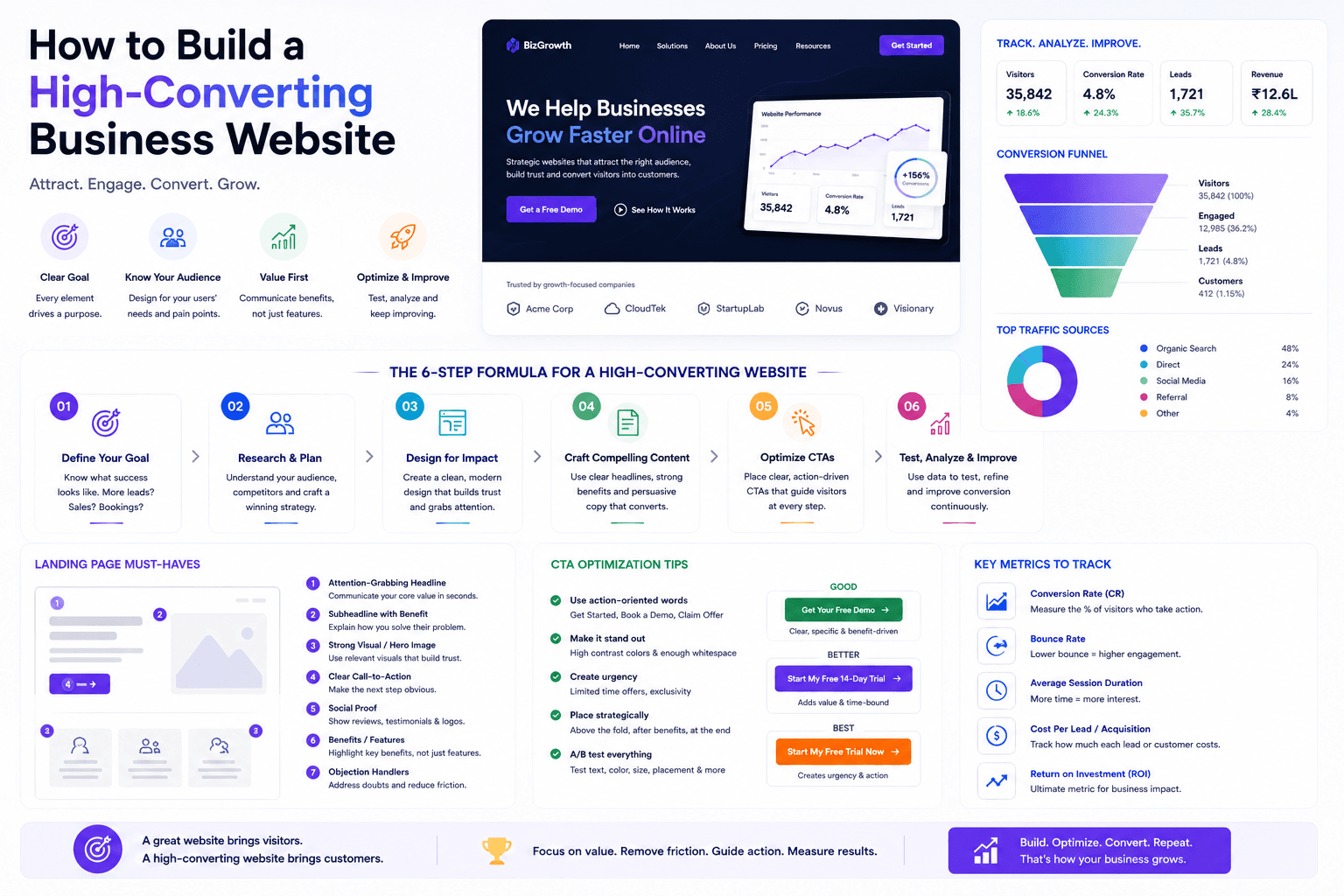
Overview
A high-converting business website does not depend on one clever design trick. It works because the message is clear, the next step is obvious, and the visitor sees enough proof to trust the business before leaving the page.
Modern web development is not only about design. A good website or web application needs clear messaging, fast loading, responsive layouts, SEO-friendly structure, accessibility, analytics, and a strong conversion path.
Why It Matters
Many websites look professional but still underperform because they bury the offer, scatter the calls to action, or fail to answer the buyer’s practical questions early enough.
Build around user intent: headline, proof, offer clarity, friction-free enquiry path, and fast page speed. Every section should either answer a concern or move the visitor toward action.
Examples In Practice
A services website can increase enquiry quality by placing pricing context, turnaround expectations, and case-study proof near the first CTA instead of hiding them deep in the page.
A local business landing page can reduce bounce by showing location relevance, service area, and direct contact options above the fold for mobile users coming from search.
What A Good Decision Looks Like
The right answer is rarely the most complicated version of how to build a high-converting business website. A sensible decision starts with the problem people are experiencing today, the outcome the business needs, and the constraints around budget, data, team capacity, and timing. This makes it easier to separate a useful investment from a feature that only sounds impressive in a planning meeting.
Before committing, write down what success should look like in day-to-day work. It could be quicker lead follow-up, fewer support handoffs, clearer reporting, a smoother buying journey, or less time spent correcting errors. Give that outcome an owner and a simple baseline so the team can compare the result after launch instead of relying on instinct alone.
It also helps to speak with the people who will use the system every day. They usually know which exceptions matter, where information goes missing, and which shortcuts keep work moving. Bringing that context into discovery produces a more practical solution and makes adoption much easier once the work goes live.
How To Approach It
A good implementation begins with a short discovery phase. Map the current process from the first trigger to the final outcome, including the people involved, existing tools, data quality, approval points, and the moments where work slows down. This gives the project a shared source of truth before design or development begins.
From there, shape the work into a realistic roadmap: define the smallest valuable version, design the user flow, build and test it with real scenarios, launch carefully, and improve from evidence. A phased approach protects the budget, reveals issues earlier, and avoids spending months on features that do not change the business outcome.
Keep a human review path for important decisions, especially where money, customer commitments, or sensitive information is involved. Clear ownership, useful reporting, and regular feedback after launch are what turn a one-time project into a system the team can depend on.
- Start with the business outcome before choosing tools.
- Map the current workflow, users, data, risks, and approval points.
- Build a focused version first, then improve from real usage.
- Measure speed, conversion, reliability, support load, and operational savings.
- Keep the system maintainable with clear architecture and documentation.
Where STEXRA Can Help
STEXRA designs websites as conversion systems, connecting copy, layout, speed, and analytics so the site performs as a sales asset instead of a brochure.
STEXRA can help with Website Development, Website Design, SEO Friendly Website Development, and related work such as AI workflow automation, website design, web application development, custom software development, API development, and business automation.